How to Respond to an RFP
A comprehensive, step-by-step walkthrough of the entire RFP response process — from the moment a Request for Proposal lands on your desk to the moment you click submit. Whether you are a first-time responder or a seasoned proposal team, this guide covers the strategy, structure, and tools you need to win.
What is an RFP?
A Request for Proposal (RFP) is a formal document issued by an organization inviting vendors to submit a structured proposal for a defined project, product, or service. RFPs are the standard procurement mechanism for high-value purchases where the buyer wants to compare multiple vendors on an equal footing against specific evaluation criteria.
RFPs are used across industries, but they are especially common in three contexts:
- Government procurement — Federal, state, and local agencies are often legally required to use competitive bidding processes for contracts above a certain threshold.
- Enterprise purchasing — Large companies use RFPs to evaluate vendors for major technology implementations, consulting engagements, and outsourced services.
- Technology and SaaS — Companies evaluating platforms, integrations, or managed services often issue RFPs to compare capabilities, security posture, and total cost of ownership.
What evaluators actually prioritize varies by organization, but the most common scoring categories are: compliance with mandatory requirements (this is table stakes), demonstrated understanding of the problem and project scope, pricing and total cost of ownership, and differentiators that separate your approach from the competition. Understanding these priorities is critical because it determines how you should structure and weight your response.
Receive & Triage (Go/No-Go Decision)
The single most impactful step in your RFP process is the one most teams skip: deciding whether to respond at all. Every RFP response consumes 40 to 100+ hours of collective effort from your most skilled people. Pursuing an RFP you have a low probability of winning is one of the most expensive mistakes a sales engineering or proposal team can make.
Build a formal Go/No-Go scoring matrix that evaluates each opportunity against five key dimensions:
- Capability alignment — Can you deliver what the RFP requires with your current product or team? If more than 20% of mandatory requirements are outside your capabilities, the probability of winning drops dramatically.
- Timeline feasibility — Is the submission deadline realistic given your current workload and the complexity of the requirements?
- Budget range — Does the expected contract value justify the cost of responding? Is the client's budget in the range your pricing supports?
- Competitive landscape — Who else is likely to bid? Is this wired for an incumbent? Do you have an informational advantage or disadvantage?
- Relationship strength — Do you have an existing relationship with the issuing organization? Were you involved in shaping the RFP's requirements?
Score each dimension on a 1-5 scale and set a minimum threshold (typically 15-18 out of 25) below which you automatically decline. This simple discipline can double your win rate by ensuring you only invest in opportunities where you have a genuine competitive advantage.
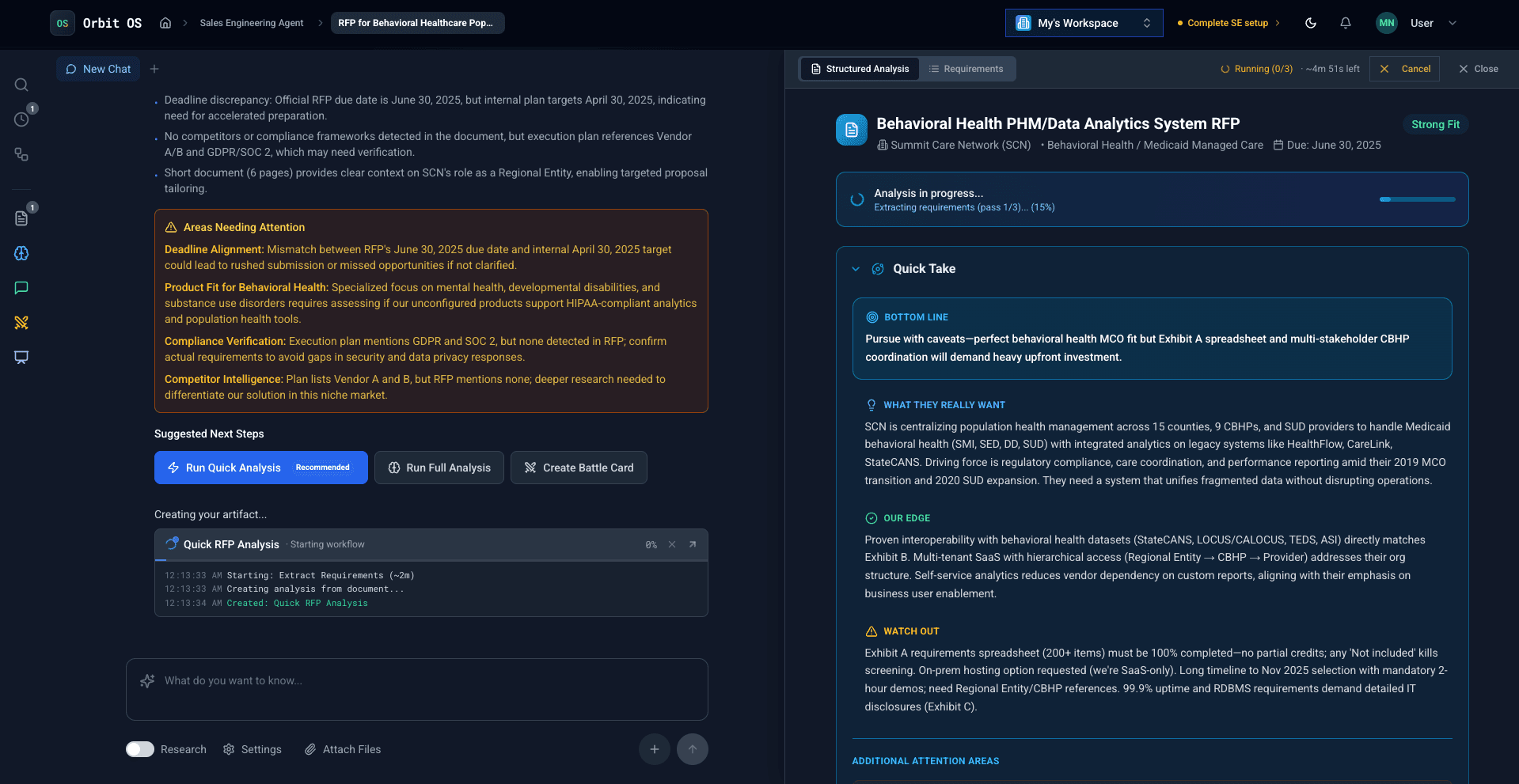
AI-powered RFP triage: instant fit score and risk assessment
Extract & Classify Requirements
Once you have decided to bid, the next step is to deconstruct the RFP into a structured requirements matrix. This is the foundation everything else is built on — your outline, your compliance tracking, your section assignments, and your review checklist all derive from this matrix.
Go through the RFP document page by page and extract every requirement into one of four categories:
- Mandatory requirements — Items explicitly marked as required, must-have, or mandatory. Failing to address any one of these is usually disqualifying.
- Optional / preferred requirements — Items described as "preferred," "desirable," or "nice-to-have." These are scoring opportunities, not requirements for qualification.
- Compliance items — Legal, regulatory, insurance, and certification requirements that must be documented with evidence.
- Submission format rules — Page limits, font requirements, section ordering, file format specifications, and portal upload instructions.
Pay close attention to implicit requirements — things the RFP assumes you will address without explicitly listing them. Experienced evaluators often test for this: they know the requirement is obvious to any qualified vendor and use it as a filter.
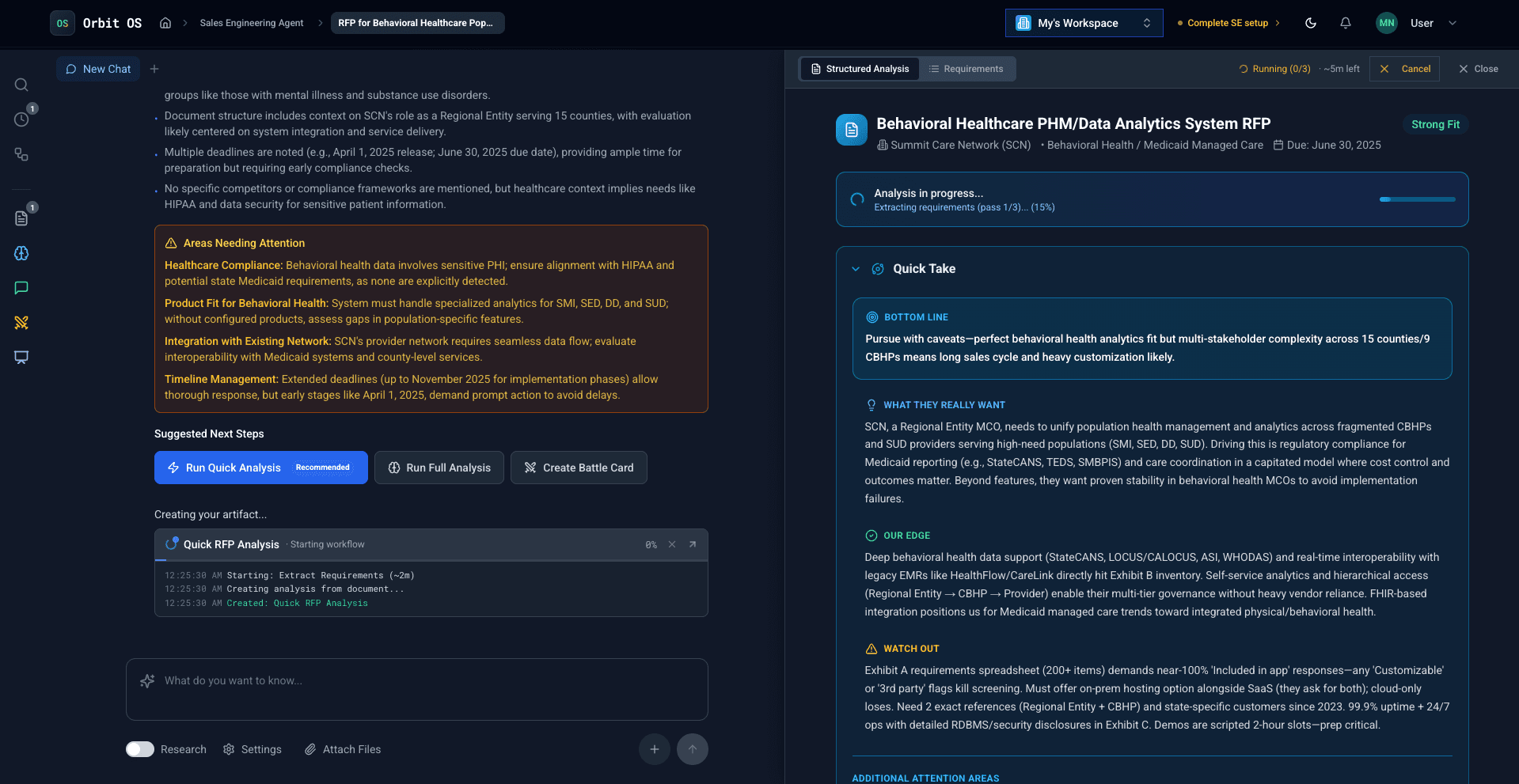
AI-extracted requirements classified by priority and compliance criticality
Build Response Team & Plan
An RFP response is a team effort. The quality of your final submission depends directly on having the right people responsible for the right sections with enough time to do their work well. Unclear ownership is the number one reason RFP responses miss deadlines or deliver inconsistent quality.
Start by mapping each section of the response to an owner. Typically, the team includes:
- Proposal lead / coordinator — Owns the timeline, compliance checklist, and final assembly. This person is the single point of accountability.
- Subject matter experts (SMEs) — Technical leads, product managers, or engineers who write the technical and solution sections.
- Pricing and commercial — Finance or deal desk to build the pricing model and handle commercial terms.
- Executive sponsor — Senior leader for the executive summary and to unblock resource issues.
Next, build a response timeline by working backward from the submission deadline. A reliable structure:
- Week 1: Requirements review, outline finalized, section assignments confirmed
- Week 2-3: First drafts from all section owners due
- Week 3-4: Internal review, compliance check, revisions
- Final 3-5 days: Executive summary, final formatting, QA, submission
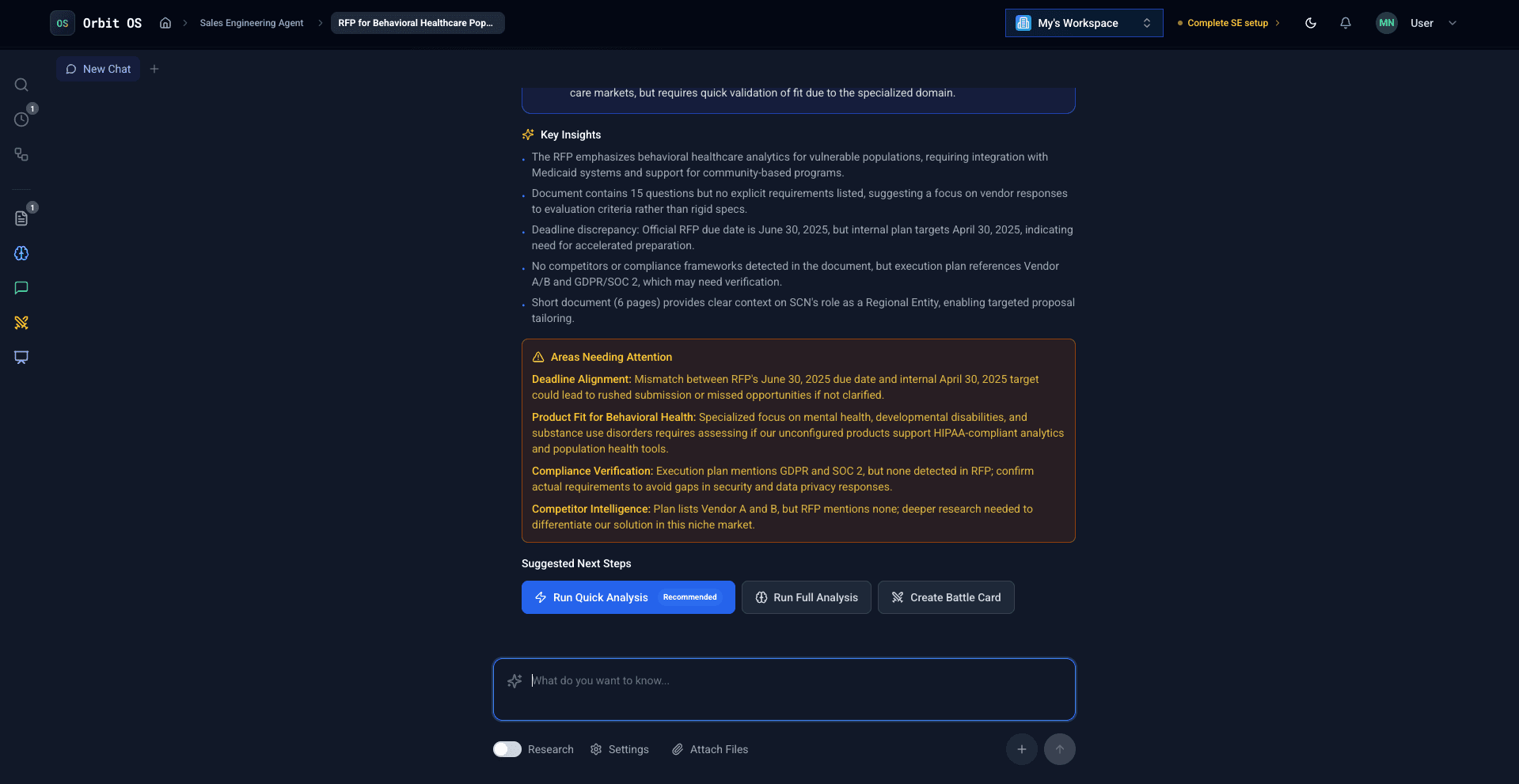
Automated execution plan with milestones and section assignments
Create Response Outline
Your outline is the blueprint for the entire response. A well-structured outline ensures consistency across sections, prevents duplication, and makes it immediately clear to the evaluator that you have organized your response to address their priorities.
The golden rule: mirror the RFP's structure exactly. If the RFP specifies five sections with specific numbering, your response should have the same five sections with the same numbering. This is not about creativity — it is about making the evaluator's job easy. The easier it is for them to find your answer to each requirement, the higher you will score.
Within that structure, plan the content strategy for each section:
- Map each mandatory requirement to the section where it will be addressed — this becomes your compliance matrix.
- Identify which case studies and proof points are most relevant to each section.
- Note where your key differentiators should appear — ideally in the sections with the highest evaluation weight.
- Flag sections that require input from specific SMEs or external partners.
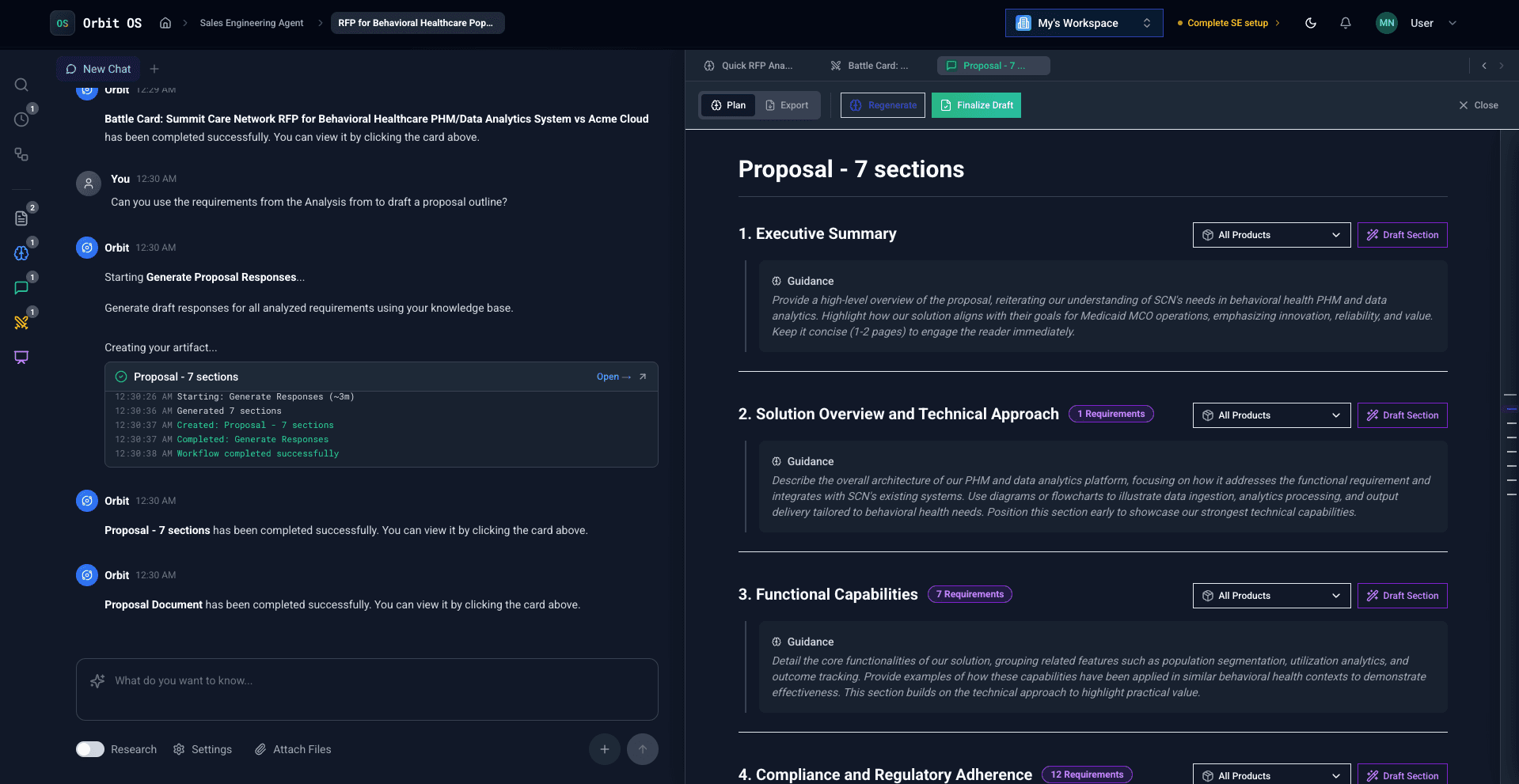
Structured outline with compliance mapping and differentiator placement
Write & Draft Sections
This is where the majority of time is spent — and where most teams struggle. The challenge is not just writing well; it is writing strategically. Every paragraph should either address a requirement, prove a capability, or differentiate you from the competition. Anything that does not serve one of those purposes is filler that dilutes your response.
Write section by section, following these principles:
- Lead with the evaluator's priorities — Open each section with a direct response to the most important requirement, not a preamble about your company.
- Use concrete examples — Replace "we have extensive experience" with "we completed a similar implementation for [Client] in 2024, reducing their processing time by 42%."
- Include metrics — Quantified results are the most persuasive element in any proposal. Numbers create credibility in a way that adjectives cannot.
- Avoid generic language — Phrases like "industry-leading," "best-in-class," and "world-class" are meaningless without evidence. Cut them.
- Write for skimming — Evaluators review many proposals. Use clear headings, bullet points, tables, and bold text to make key information scannable.
If you have a content library from previous proposals, this is where it pays dividends. Pull in approved language, update it for this context, and spend your time on the net-new content that is specific to this opportunity.
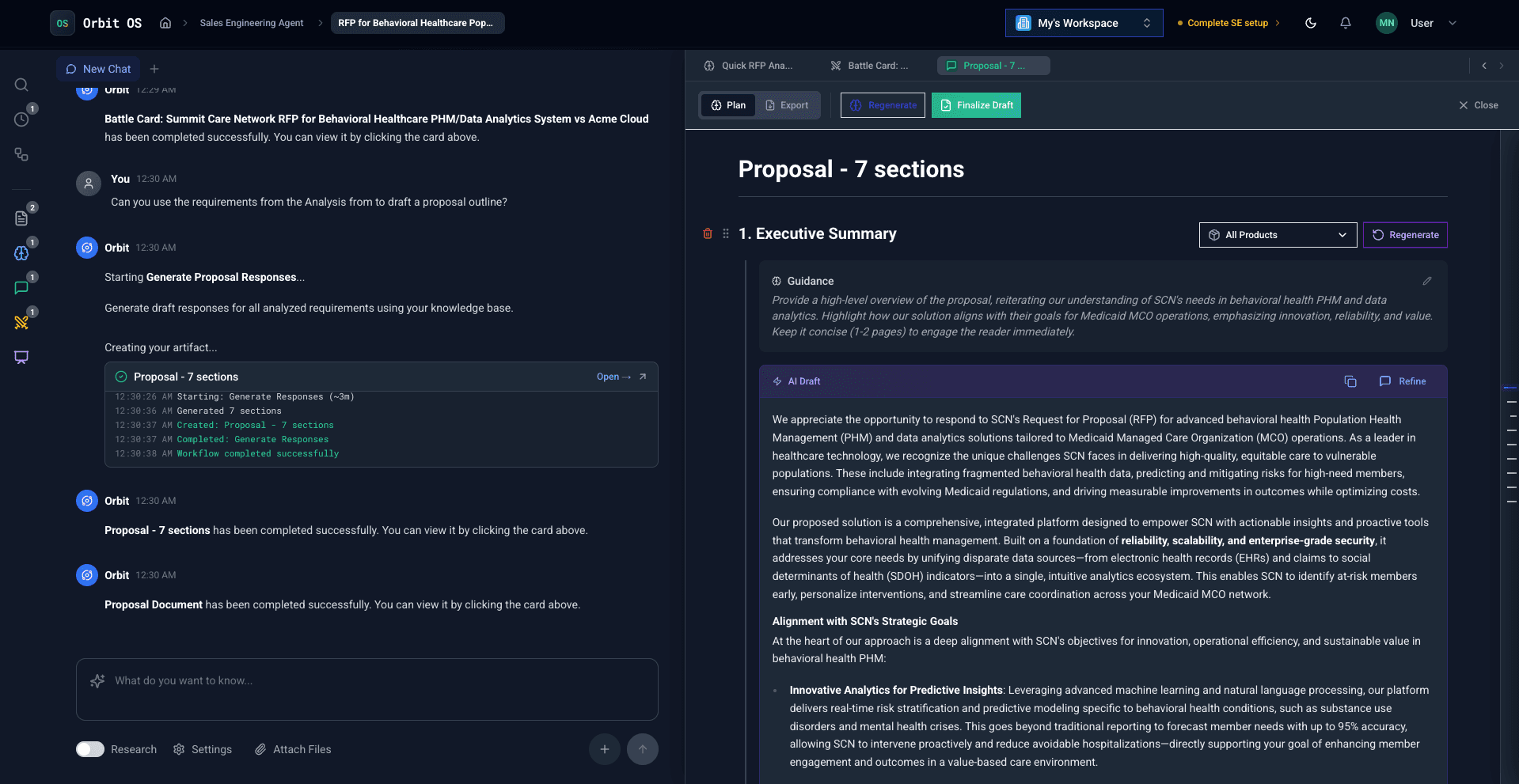
Section-by-section draft generated from your knowledge base and RFP requirements
Respond to RFPs 10x Faster
Stop scrambling to meet deadlines. Upload your RFP and get a structured, compliant response draft in minutes — not weeks.
Try the Sales Engineering AgentCompetitive Differentiation
Compliance gets you considered. Differentiation gets you selected. Even a perfectly compliant response will lose to a competitor who does a better job explaining why their approach is uniquely suited to the client's needs.
Start with competitive intelligence. Research which companies are likely to bid on this opportunity and develop an understanding of their strengths, weaknesses, and typical positioning. This does not mean disparaging competitors in your response — it means knowing what they will claim so you can preemptively differentiate.
Build three assets for this step:
- Win themes — 2-3 core messages that run through the entire proposal. These are the reasons the evaluator should choose you, stated in terms of their priorities. For example: "Fastest time to value through our pre-built integrations" or "Lowest risk through our proven track record with similar implementations."
- Competitive battlecards — Internal reference documents for each likely competitor covering their positioning, pricing model, known weaknesses, and how to counter their likely claims.
- Objection handlers — Pre-written responses to the most likely concerns an evaluator might have about your company, product, or approach — such as company size, geographic coverage, or technology maturity.
Weave your win themes into every major section of the response. Evaluators who read multiple proposals benefit from clear, consistent messaging about why you are the best fit.
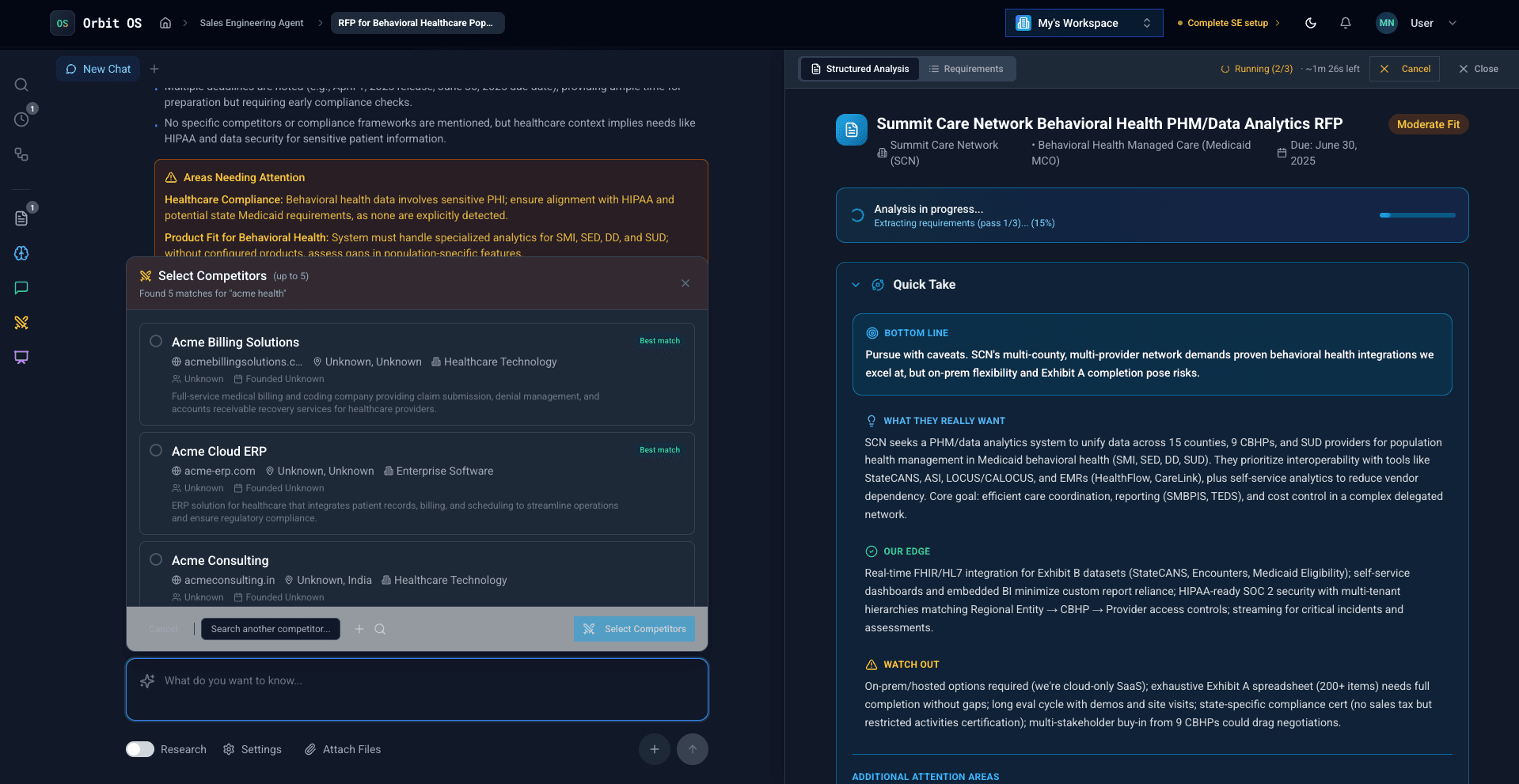
AI-generated competitive battlecard with differentiators and objection handlers
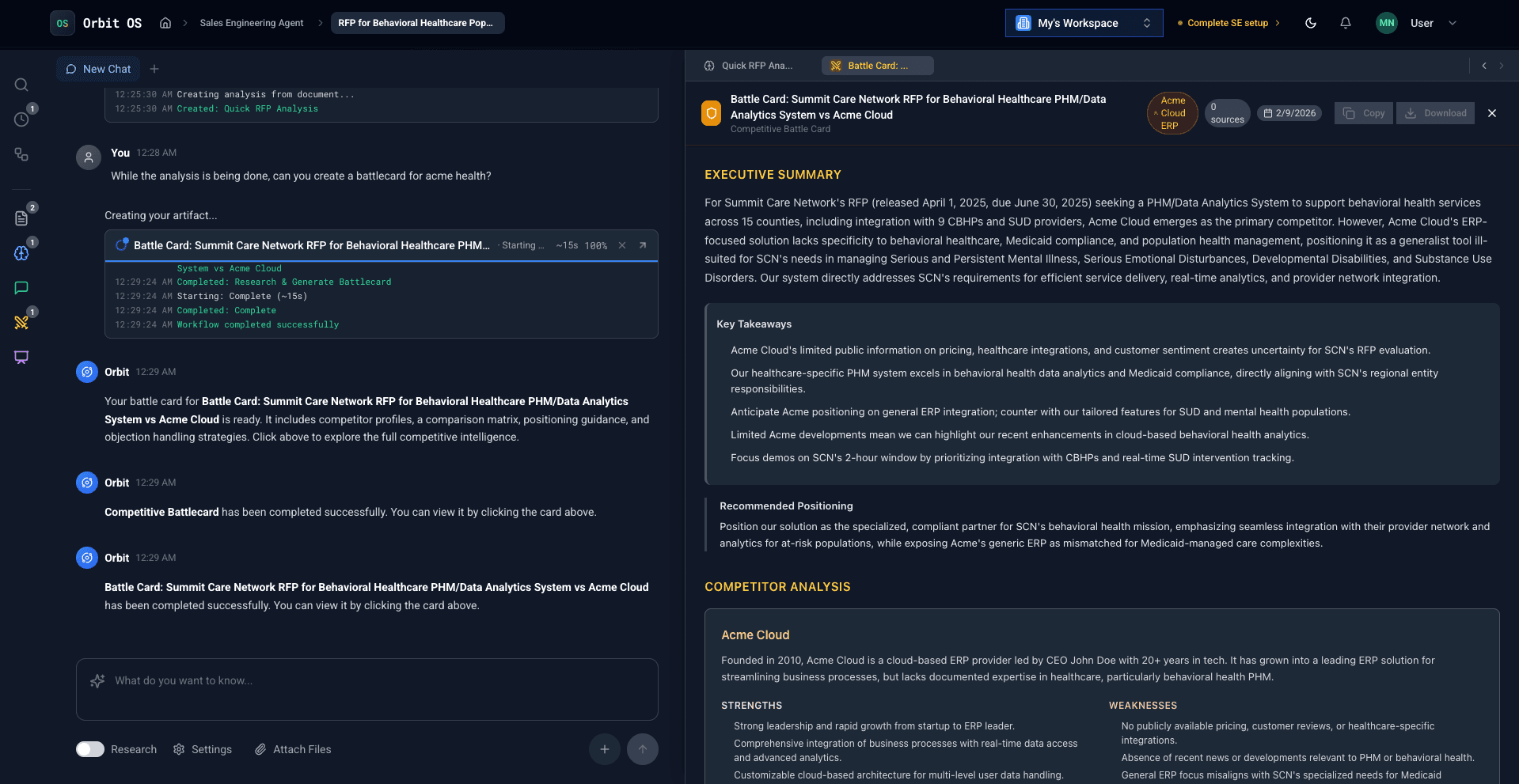
Detailed battlecard view with win themes and competitive positioning
Review & Compliance Check
A strong draft means nothing if it is non-compliant. This step is where you pressure-test your response against the original requirements and make sure nothing was missed, misinterpreted, or insufficiently addressed.
Run at least three review passes:
1. Compliance review
Go through your requirements matrix line by line and verify that every mandatory requirement has been explicitly addressed in the response. Check that all formatting rules, page limits, and submission requirements are met. This is a binary pass/fail check — do not move forward until every mandatory item is covered.
2. Red-team review
Have someone review the response from the evaluator's perspective. Ask them to score each section using the evaluation criteria from the RFP. Where would a competitor score higher? Where is your argument weakest? Where are you making claims without evidence? This adversarial review surfaces weaknesses you are too close to see.
3. Quality and consistency
Proofread for tone consistency, formatting alignment, grammar, and factual accuracy across sections. When multiple authors contribute, voice and quality can vary — this pass smooths everything into a cohesive document that reads as a unified response.
Common issues caught during review include: referencing the wrong client name (from a reused section), inconsistent pricing between the narrative and pricing table, outdated team bios, and missing appendices that are referenced in the body.
Format, Export & Submit
The final step is often underestimated. Formatting, assembly, and submission logistics have derailed more proposals than most teams care to admit. Do not treat this as an afterthought — allocate a full day for this step.
Work through a final submission checklist:
- Format to specification — Apply all formatting requirements from the RFP: fonts, margins, page numbering, headers/footers, section breaks. If the RFP specifies Word format, submit Word. If it specifies PDF, submit PDF.
- Write the executive summary last — The executive summary should be a standalone document that conveys your win themes, key differentiators, and value proposition in 1-2 pages. Write it after the full response is complete so it accurately reflects the content.
- Assemble appendices — Gather all supporting documents: resumes, certifications, insurance certificates, case studies, reference letters, product architecture diagrams.
- Test everything — Open the final file on a different machine. Check that images render, links work, and the table of contents is accurate. If submitting through a portal, test the upload before the deadline.
- Submit early — Aim to submit at least 24 hours before the deadline. Portal crashes, file size limits, and last-minute formatting issues are surprisingly common.
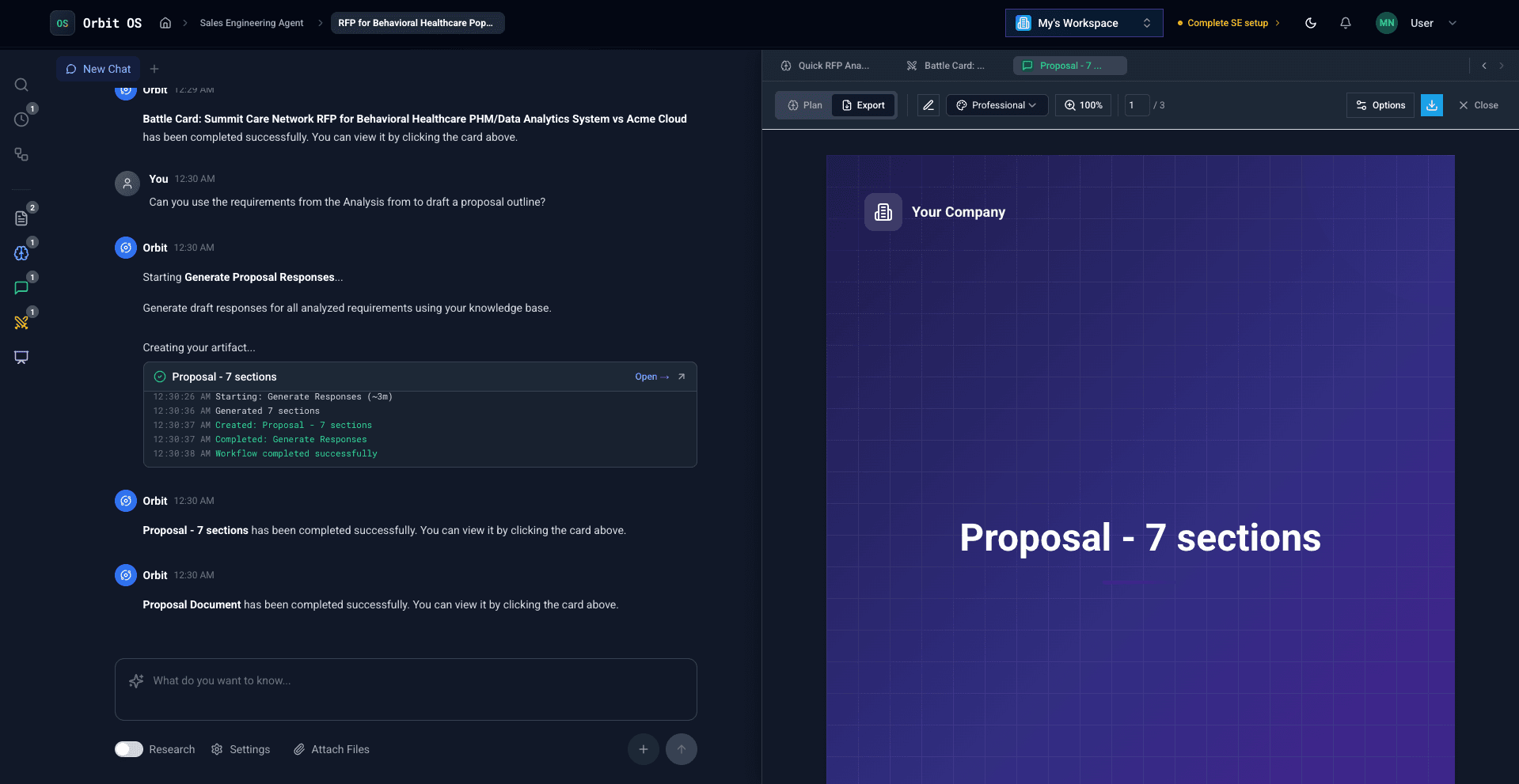
Export your completed proposal in any format with formatting preserved
RFP Response Best Practices
Tactical tips from teams that consistently win competitive bids.
Start with compliance
Address every mandatory requirement first before elaborating on value-adds. Missing a single mandatory item can disqualify your response regardless of how strong it is otherwise.
Mirror the RFP structure
Organize your response to match the RFP section-by-section. This makes it easy for evaluators to find your answers and score them against their rubric.
Lead with differentiators
Open each section with what makes your approach unique, not a list of features. Evaluators read dozens of responses — lead with the reason to choose you over everyone else.
Use metrics and case studies
Quantified results from similar engagements are the most persuasive element in any proposal. Replace "we deliver excellent results" with "we reduced costs by 34% for a comparable client."
Build a reusable content library
Maintain a centralized repository of approved company descriptions, bios, case studies, and common Q&A responses. This cuts drafting time dramatically for every future RFP.
Leave time for two review rounds
Plan for at least one compliance review and one quality review before submission. Rushed reviews miss errors that cost you the deal.
Get a non-expert to review for clarity
Have someone outside the project team read your response. If they cannot understand your key messages, the evaluator probably will not either.
Submit 24 hours early
Technical failures, last-minute formatting issues, and upload errors are more common than you think. An early submission deadline gives you a buffer against the unexpected.
RFP Response FAQ
Common questions about the RFP response process
Most RFP responses take between 2 and 6 weeks depending on the complexity of the requirements, the size of the response team, and how much reusable content you already have. Simple RFPs with straightforward requirements can sometimes be turned around in a week, while large government or enterprise RFPs with hundreds of requirements may take the full 6 weeks or more. AI-powered tools can compress this timeline dramatically by automating requirement extraction, first-draft generation, and compliance checking — teams using these tools regularly cut their response time by 60-80%.
A Go/No-Go decision is a formal assessment of whether your organization should invest the time and resources required to respond to a particular RFP. It matters because responding to every RFP that crosses your desk is one of the most common and costly mistakes teams make. Each response consumes significant time from your best people — often 40-100+ hours of collective effort. A structured Go/No-Go process evaluates factors like strategic alignment, win probability, resource availability, and competitive positioning so you only pursue opportunities where you have a realistic chance of winning.
Always mirror the RFP's structure exactly. If the issuer provides a required format, section numbering, or template, follow it to the letter — evaluators often score responses partially on how easy they are to review against their criteria. Include a compliance matrix that maps each requirement to the specific section of your response where it is addressed. Use clear headings, consistent formatting, and professional typography. If the RFP specifies page limits, font sizes, or margin requirements, treat those as mandatory even if they seem like suggestions.
The strongest RFP responses demonstrate three things: deep understanding of the client's specific problem, concrete proof that you can solve it, and a clear explanation of why your approach is better than alternatives. Use specific examples with quantified outcomes (e.g., 'reduced processing time by 42% for a similar client') rather than generic capability statements. Show that you read the RFP carefully by referencing specific requirements and pain points the issuer mentioned. A compliance-first approach — where you clearly address every mandatory requirement before elaborating on differentiators — signals professionalism and attention to detail.
Yes, and you should. Building a content library of reusable sections — company overviews, team bios, case studies, technical descriptions, compliance language, and past answers to common questions — is one of the highest-leverage investments a proposal team can make. The key is to always customize reused content for the specific opportunity. Generic boilerplate is easy for evaluators to spot and signals that you did not invest real effort in the response. Use your library as a starting point, then tailor the language, examples, and emphasis to match this particular client and their stated priorities.
Transparency is almost always the best strategy. Evaluators are experienced professionals who can detect when a vendor is overpromising or being evasive. If you cannot fully meet a requirement, acknowledge it directly, propose a viable alternative or workaround, and explain your roadmap for closing the gap if applicable. For example: 'Our platform does not currently support X natively. However, we offer Y integration that achieves the same outcome, and native support for X is scheduled for Q3 2025.' This approach builds trust and often scores better than vague claims of full compliance that fall apart during due diligence.
Always include references if the RFP allows or requests them. Choose references that are relevant to the specific industry, project size, and problem domain of the RFP — a reference from a similar organization carries far more weight than a big-name logo in an unrelated field. Prepare your references in advance by letting them know they may be contacted, briefing them on the opportunity, and confirming they are willing to speak positively about your work. Include a brief description of each reference engagement with quantified outcomes where possible.
Win More RFPs Without the Scramble
Join teams using AI to analyze RFPs, generate compliant responses, and build competitive battlecards — while they focus on strategy.